



Menu

Global Standards Assurance (GSA)

HIGG FEM empowers factories to optimise processes, reduce waste, and enhance their environmental footprint.

What is Higg FEM?

The Higg Facility Environmental Module (Higg FEM) is a sustainability assessment tool developed by Cascale (formerly Sustainable Apparel Coalition).It helps manufacturing facilities in the apparel, footwear, and textile industries measure their environmental performance. Higg FEM evaluates key impact areas such as energy use, water consumption, wastewater, air emissions, waste, and chemical management.

The tool uses a standardised approach for self-assessment and verification to ensure comparability and credibility. It encourages facilities to identify environmental risks and drive continuous improvement. Brands and retailers use Higg FEM data to inform responsible sourcing and supply chain strategies. The scoring system reflects both the maturity of environmental management practices and performance outcomes.

Cascale regularly updates the module to align with best practices and regulatory developments. Participation in Higg FEM promotes greater transparency and accountability in the global supply chain. By adopting Higg FEM, companies demonstrate their commitment to reducing environmental impact.

Let’s Talk About Your Business

Main Focus Areas of Higg FEM

Environmental Management Systems – Policies, procedures, and improvement plans.

Energy Use & Greenhouse Gas Emissions – Energy efficiency and carbon reduction.

Water Use – Consumption monitoring and conservation efforts.

Wastewater – Treatment systems and compliance with legal standards.

Emissions to Air – Managing emissions from production processes.

Waste Management – Efficient segregation, reduction, and disposal.

Chemical Management – Responsible chemical handling, storage, and disposal.

Benefits of Higg FEM

Global Recognition

Higg FEM is widely recognised by international brands and retailers as a trusted standard for assessing environmental performance. Participation enhances a facility’s credibility, supports responsible sourcing decisions, and demonstrates a clear commitment to sustainability across the global supply chain.

Performance Benchmarking

Higg FEM enables facilities to benchmark their environmental performance against industry standards and peers. By using consistent metrics, it helps identify strengths and areas for improvement, driving continuous progress and fostering a culture of sustainability and accountability.

Supply Chain Transparency

Higg FEM promotes transparency by providing a standardised framework for facilities to report their environmental performance. It enables brands and retailers to access consistent, verified data, supporting informed sourcing decisions and fostering accountability throughout the supply chain.

Environmental Risk Mitigation

Higg FEM supports facilities in identifying and addressing environmental risks through structured assessments and data tracking. By highlighting gaps in compliance and management practices, it enables proactive measures that reduce the likelihood of environmental incidents and enhance long-term operational resilience.

Resource Efficiency

Higg FEM helps facilities identify areas of high resource consumption and inefficiency through structured environmental assessment. By tracking data on energy, water, and waste, it supports targeted improvements that reduce operational costs and environmental impact, driving smarter resource management.

Higg FEM Verification Process


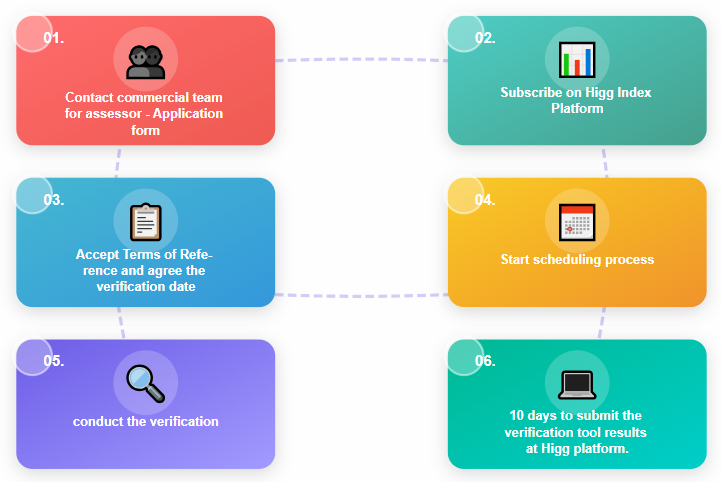
Self-Assessment

In this initial phase, the facility completes the Higg FEM self-evaluation. It covers key areas such as energy use, water and wastewater management, waste handling, and chemical practices. This helps facilities identify their environmental performance baselines.


Verification Request

A qualified and Higg-approved Verifying Body (VB) is selected to independently review the self-assessment. Their role is to ensure the accuracy and completeness of the submitted data and that it aligns with Higg FEM standards.


On-Site or Virtual Verification

The verifier conducts a thorough review that may include document checks, on-site inspections, and staff interviews. This step ensures that all practices reported in the self-assessment are credible and reflect the facility’s actual performance.


CReporting and Scoring

Once verification is complete, the facility receives a detailed report highlighting any discrepancies, areas of compliance, and opportunities for improvement. This helps guide future actions to enhance sustainability performance. The verified Higg FEM data can then be shared with brands, retailers, and other stakeholders
How GSA Can Support You

As an SAC-approved Verification Body, GSA provides expert-led Higg FEM verification services that are accurate, efficient, and aligned with industry best practices. We support facilities at every step—from preparing for the assessment to post-verification feedback. Our auditors are regionally based and highly experienced in environmental sustainability, ensuring practical guidance tailored to your operations.

Why Choose GSA?

UK Based Certification Body with operational presence in Pakistan, Bangladesh, MENA.

SAC-Approved Verifier for Higg FEM.

Experienced Auditors with deep knowledge of environmental standards.

Customer-Centric Approach – We prioritize clarity, responsiveness, and long-term relationships.

Multilingual Support for effective communication across diverse regions.

Frequently Asked Questions (FAQs)

Manufacturing facilities in the textile, apparel, and footwear industries, especially those supplying to sustainability-focused brands, are encouraged or required to complete the Higg FEM.

No, the Higg FEM is a self-assessment and verification system, not a traditional certification. However, verified scores demonstrate environmental responsibility and credibility.

The Higg FEM is typically completed annually, followed by a verification process if required by the brand or partner.

Self-assessment is the facility’s own evaluation, while verification is an independent review conducted by an SAC-approved verifier to ensure accuracy and reliability.

Start by thoroughly completing the self-assessment, gathering supporting documentation, and engaging with a verifier like GSA early to ensure readiness.

Depending on the facility size and scope, a verification may take 1–2 days, plus additional time for reporting and submission.

Yes. GSA is officially approved by the Sustainable Apparel Coalition (SAC) to conduct Higg FEM verifications for facilities worldwide.